The instruction Nichola DePass received from her clients at the start of this project was a simple one. They wanted their Jupiter home to feel like a beautiful luxury hotel. Not like something inspired by a hotel. Like one. Her answer was a romantic Parisian chic hotel. Her clients said yes immediately, and from that single agreed-upon premise, every decision that followed found its footing.
Casa O is the result, a residence that carries its hotel ambition without apology and without pastiche. Getting it to feel inevitable rather than assembled was, as DePass puts it, “anything but effortless.”
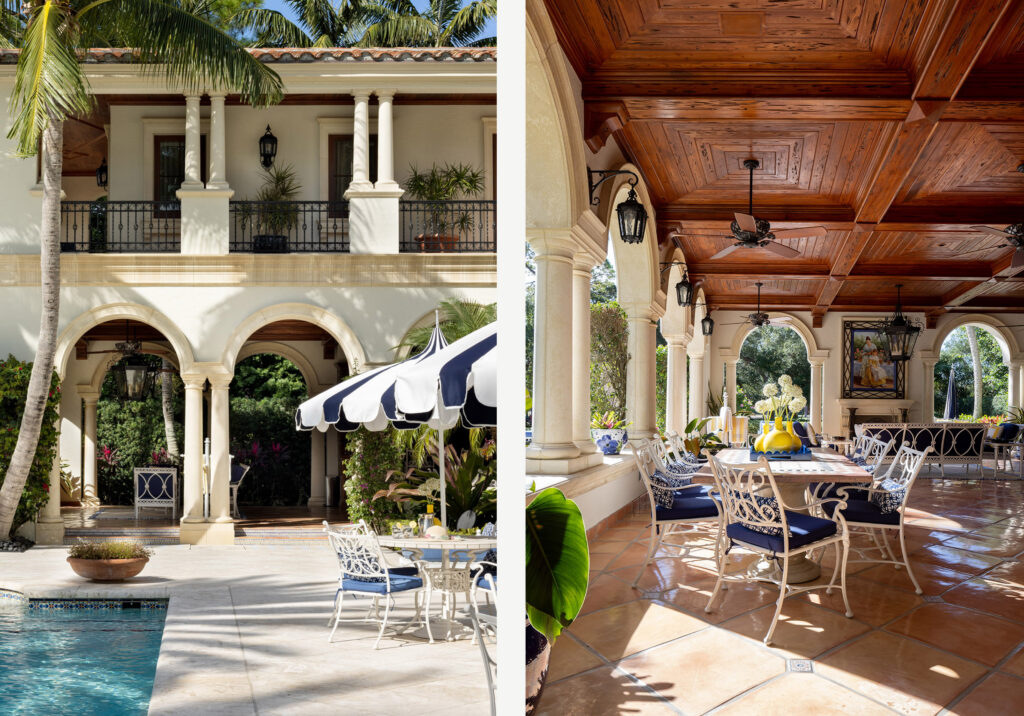
The home arrived with substantial bones, the arched loggias and painted ceilings and ironwork that moves between classical and ornate depending on where you stand. Rather than treating any of it as an obstacle, DePass and her team at Nichola Francesca LLC chose to work with every inherited element. “We did not remove any of them,” she notes. “Their supporting roles allowed enough flexibility for us to build around them.”
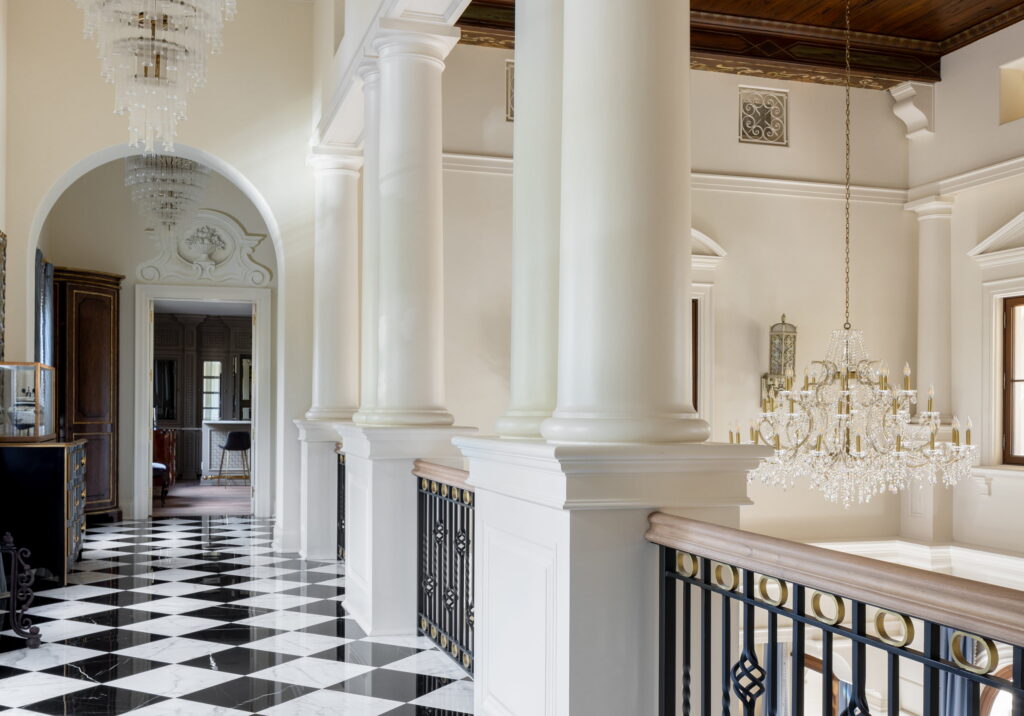
What they built around them is genuinely hard to categorize, which is part of the point. The house holds what DePass describes as a “Gatsby-like atmosphere” that layers traditional and transitional gestures with splashes of modern and a nod to Art Deco. The bar is intimate and moody, its stone counter and antiqued mirrored back more downtown than chateau, while the upper level reads like something from a grand European institution. The distance between those two rooms, and the fact that neither apologizes for the other, is what the design had to earn.
Light as a Through-Line
At Casa O, the lighting does not defer to the architecture. It answers it. Throughout the house, crystal fixtures appear in forms that range from cascading drops to branching arrangements to globe shapes. Each one introduces a contemporary sensibility into rooms built on classical proportion, and none of them overpowers the room it sits in.

The staircase is where that tension is most legible. Descending the full height of the space is a cascading crystal fixture of considerable scale. DePass describes it as “massive and striking, yet so light and airy at the same time.” The same logic holds through every room, from the vaulted corridor painted sky blue with botanical motifs and gold lanterns overhead, to the primary bath where a freestanding tub sits beneath its own sculptural crystal fixture. “None truly fought for the lead.”
The Room That Tips the Balance
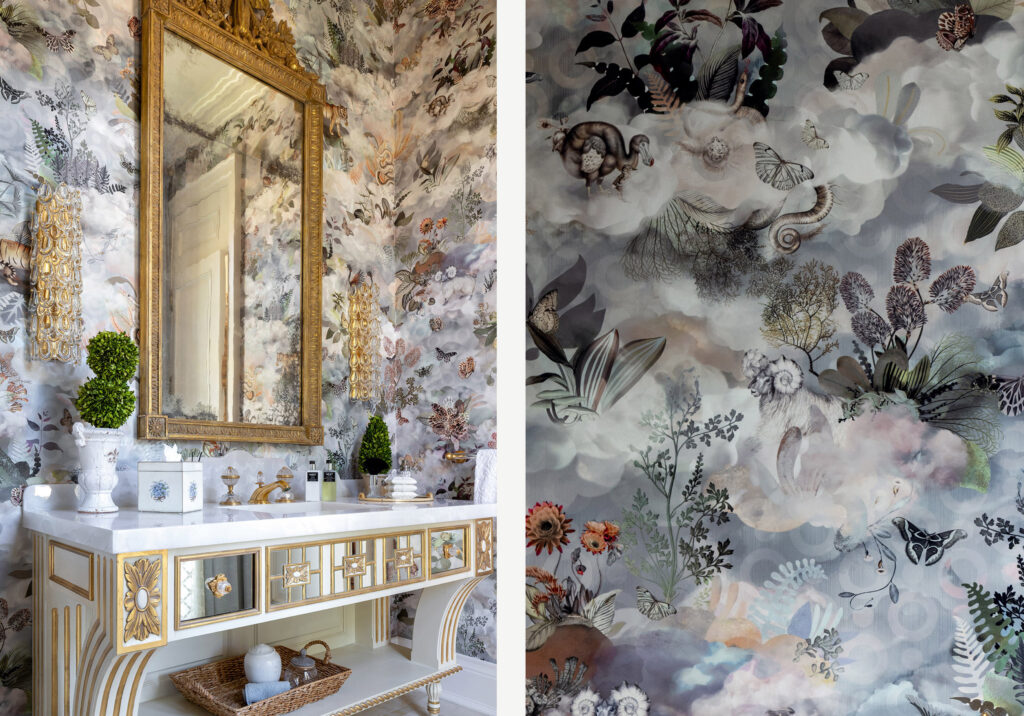
There is a moment in every house of this ambition where the designer steps fully into their own point of view. At Casa O, that moment is the powder room. “A powder room is always a space that tips the balance drastically from one end to the other,” DePass says. “Safe or dramatic. It is very rare there is an in-between.” Her approach was unambiguously dramatic. Botanical wallpaper wraps the walls and ceiling in a dense, layered world of butterflies and foliage. A gilded carved mirror anchors the wall above a white and gold vanity whose mirrored panels and ornate carving give it the presence of a piece of furniture rather than a fixture. “Every detail in the powder was a main character on its own,” she says. “Bold and strong.”
The Whole of It
DePass and her team came to interior design from fashion, and that origin is not incidental. It is the lens through which they read every project. In fashion, nothing is considered in isolation. The dress, the accessories, the hair, the makeup. The whole is the point, and each element exists in service of it. They apply the same hierarchy to a home. Every room is a considered component of a larger composition, and the exterior is no different from the interior. “The feel of interior of Casa O was recreated for the exterior so the flow would be seamless.”
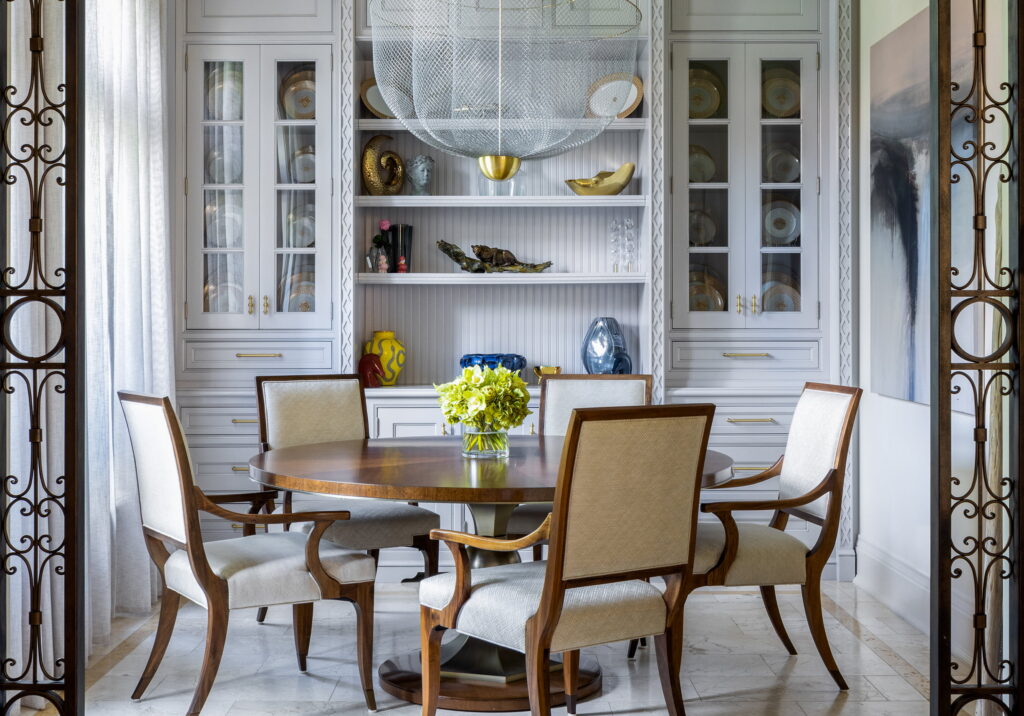
That sensibility extends to the spaces that surprised even her. The breakfast area, framed by an ornate scrollwork iron gate that echoes the ironwork woven through the rest of the house, became the project’s most unexpected standout. The Moooi fixture above the table is the detail she singles out most readily. It “secured its place so gracefully,” she says, “that it did not look out of place.” She had not fully anticipated how well it would all come together. The room became an immediate favorite for everyone who experienced it.
The dressing room, designed in close collaboration with Downsview of Juno, carries its own quiet conviction. A rolling ladder tracks the width of the built-in cabinetry, a stone-topped island anchors the center, and a crystal branch chandelier casts warm light across every surface. DePass says that seeing it in photographs is one experience. Standing in it is another entirely.
After more than two decades of practice, DePass has built her reputation on a single discipline: listening. Not for what clients say they want, but for what they mean. The advice she gives anyone weighing a project at this level has nothing to do with floor plans or finishes. Notice how you feel in the room with your designer at that first meeting, because the work will run for months and sometimes years, and that alignment shapes the result more than any material you choose. What her clients meant was the feeling of the finest hotel they had ever stayed in. What they live in now is the one thing a photograph of Casa O cannot hand you, a house you have to stand inside to understand.